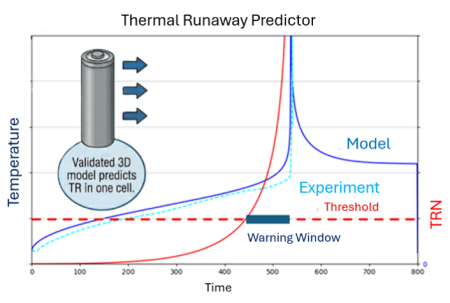
Thermal runaway represents one of the most critical safety hazards in lithium-ion energy storage systems, where self-accelerating exothermic decomposition reactions rapidly outpace the cell’s heat dissipation capabilities. In cylindrical battery formats, limited radial heat transfer allows internal core temperatures to reach critical thresholds while outer surfaces remain deceptively cool, rendering standard surface sensors unreliable for early hazard detection. To overcome this limitation, the BILDE lab develops physics-grounded, discrete heat transfer models incorporating Arrhenius kinetics to accurately predict thermal instability before catastrophic failure occurs. By continuously tracking the non-dimensional Thermal Runaway Number (TRN) and optimizing kinetic parameters through multi-objective genetic algorithms (NSGAII), our modeling framework extends the early-warning detection window by up to two minutes. This additional lead time provides a vital safety margin for next-generation Battery Management Systems (BMS) to trigger automated cooling, isolate compromised cells, or initiate emergency protocols prior to irreversible runaway.