Servo Motors

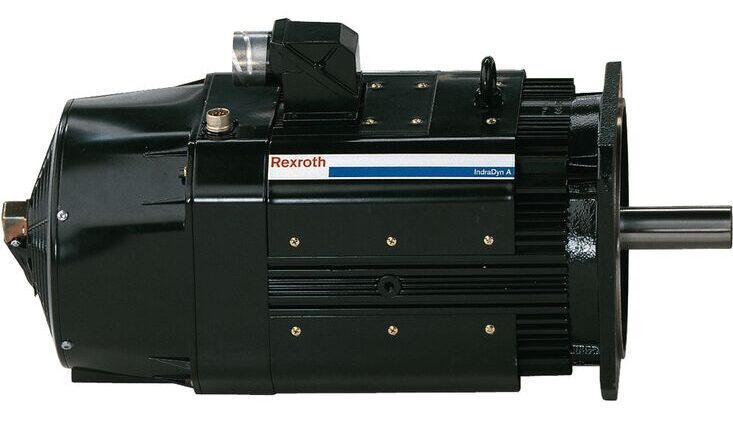
Bosch Rexroth Synchronous Servo Motor

Figure 1: Bosch Rexroth Synchronous Servo Motor

Image retrieved from https://www.boschrexroth.com/en/us/products/product-groups/electric-drives-and-controls/motors-and-gearboxes/asynchronous-servo-motors/mad

Here is a video discussing the advantages of Bosch Rexroth’s MS2N/E Synchronous Servo Motors:

References:

Servo Motors Product Selection Guide

Although most servo motors have similar specifications on paper, there are many aspects to consider when picking what type is best for a particular application.

Load

One of the most important and obvious requirements for a servo motor is determining the load. The main loads of interest for a servo motor are what the motor shaft will be rotating in any capacity. Any parts connected to the motor shaft will apply a load inertia. Specifically, the inertia of the load needs to be less than that of the inertia generated by the motor for the motor to function as intended. The moment of inertia for the motor is typically found on the datasheet. Oftentimes, designers will use a safety factor to make sure that the motor will still be capable of efficiently turning and handling a load that might not be exactly what was expected.

Electronic Control Functions

Another requirement for the servo motor that needs to be defined are the intended electronic control functions of the motor. In other words, before a servo motor is selected, the designer must know what kind of motion sequence or function the motor needs to be capable of before making a selection. The programmability and functions available with the included drive need to be considered.

Speed and Torque

Once the motion sequence has been established for the motor, the next step is to determine how fast the motor is required to turn and how much torque the motor needs to provide. Both of these characteristics will be a result of knowing the load in addition to how the load will be moved. Between similarly sized servo motors, it can be expected that a motor that provides higher speed will not produce as much torque as a motor that is only capable of a lower speed. It is important that when making a servo motor selection to not pick a motor that will be constantly running at its maximum speed. Continuous maximum output from the servo motor will decrease its lifespan and increase its maintenance time.

Power Requirement

Once the relative speed and torque requirements have been defined, the designer needs to select a power source that will be capable of powering the motor. This is not so much a step in the selection of the servo motor itself, but is something to consider if there is a limit to how much power can be supplied to a possible motor. A voltage requirement will determine the maximum power delivered by a motor in general.

Environmental and Installation Conditions

The environment that the servo motor is being installed in should play a large role in determining what servo motor to select. As a result of fast-moving and rotating parts, heat will be generated by the servo motor and transferred to the surrounding area, heating up the motor as well. The amount of heat produced by the motor also affects its performance, which is also typically denoted on the datasheet. The physical size of the motor and what the motor is being installed onto also play an important role when considering the environment and installation conditions of a servo motor. While it might be easy to go with a large motor that fits within budget to oversatisfy torque requirements, the motor might not end up fitting in the preferred orientation if the designer is not careful.

Quality

The last, but not the least, important factor when selecting a servo motor is the quality. Depending on the allowed budget for the purchase, factors such as efficiency, accuracy, and reliability of the motor can and should be considered if the motor is intended for long-term use. If the motor is going to be used in a highly specific and calibrated application, then a cheap servo motor with poor motion control will probably not meet the requirements of the application over time.
Servo Motors Product Theory

A servo motor is a motor utilizing an automatic control system to change the position of an object (An Introduction to Servo Motors). Servo is short for servomechanism which utilizes an input command, power amplification, feedback, and lastly an output. The output of the servo motor is what turns the desired object. There are many different categories and subcategories of servo motors that are made for different applications such as DC servos, AC servos, Brushless DC, Position rotation servos, continuous rotation servos, and Linear servos (Goel, 2018).

DC Servos

DC servo motors are made similarly to traditional electromagnet motors but operate differently in most aspects. DC servos are less efficient than traditional motors so they are larger in size for similar power outputs. There are different types of DC servos for different applications such as series, split series, shunt control, and permanent magnet shunt servo motors.

AC Servos

AC servo motors utilize the applications of encoders for feedback in a closed loop allowing them to be highly accurate in positioning.

Brushless DC Servos

Brushless DC motors are similar to DC motors in that they use DC electricity but they differ in that they can switch power supplies providing AC current to drive the motors individual phases in a closed loop. These motors feature a great power to weight ratio and can achieve high speeds and be utilized well from electronic control. Typical applications include power tools, computers and even applications in some vehicles.

Positional Rotation Servos

Positional rotation servo motors are the most widely used servo motor and are considered to be the most important. Positional rotation servos only have the ability to rotate 180 degrees which can be very useful for some applications such as remote controls, toys, and even planes.

Continuous Rotation Servos

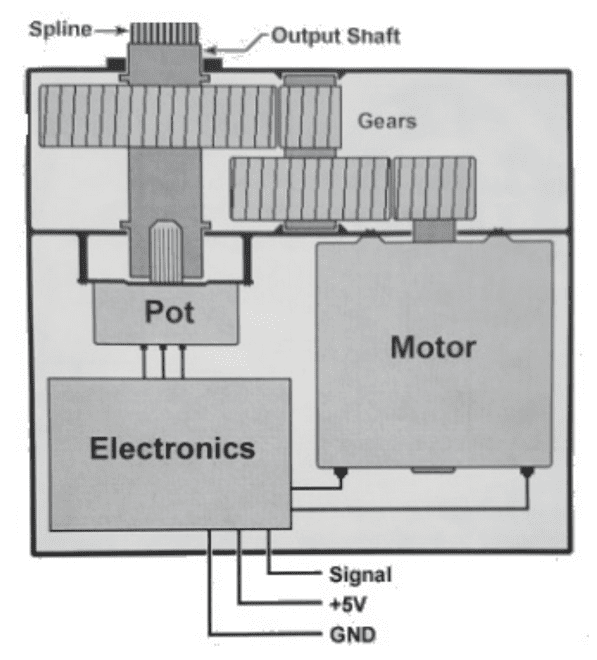
Continuous rotation servo motors are similar to positional rotation but they have the ability to rotate in either direction an unlimited amount. The direction of rotation can be changed by changing the command signal. Common applications include robots and rotating radar dishes. Although there are many different types of servo motors the main parts are the same consisting of a motor, reducing gears, and the circuity to control the motor. Shown in Figure 1 is an example of a typical servo motors internals.

Inside of a Servo Motor

Figure 1: Inside of a Servo Motor

Image retrieved from www.circuitcrush.com/servo-motor-introduction.

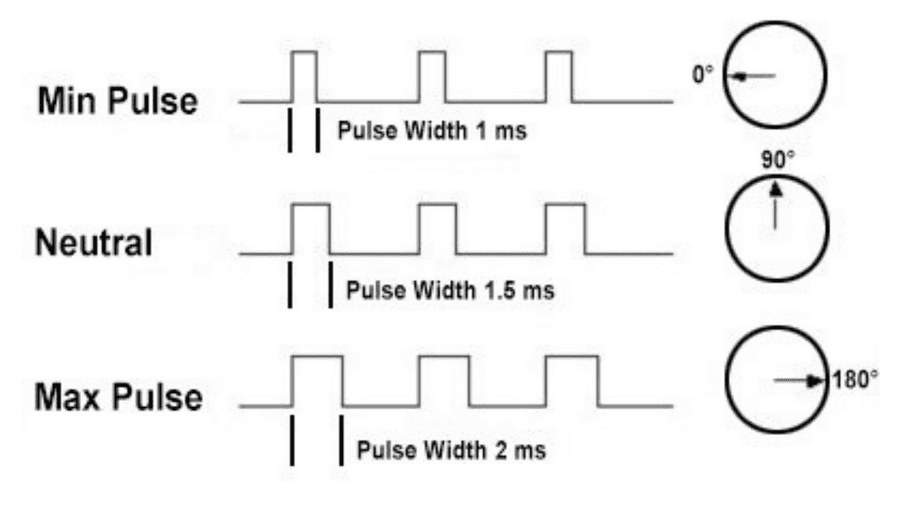
In a servo motor the motor is activated by the electronics via electrical pulses. The electrical pulses decide the angle at which the motor turns. In the example in Figure 2 it can be observed that as the pulse width increases so does the rotation of the motor.

Servo Motor Degrees of Rotation based on Pulse Width

Figure 2: Servo Motor Degrees of Rotation based on Pulse Width

Image retrieved from www.circuitcrush.com/servo-motor-introduction.

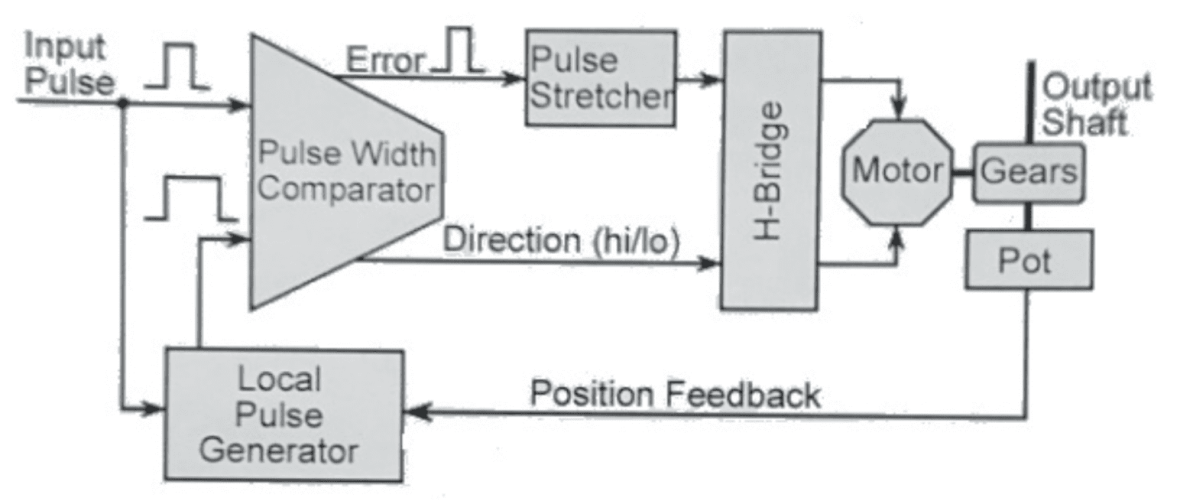
To achieve an accurate rotation of the motor the servo needs around 50 pulses a second which is known as the servos frame rate. From Figure 4 it can be determined that a 1millisecond pulse width will move the shaft to its 0 degree position as well as a1.5millisecond pulse width resulting in the 90 degree position and a 2millisecond pulse width resulting in a 180 degree position. Since a servo motors pulse width can have some error there must be more complicated electronics as shown in Figure 3 to fix this.

Servo Motor Block Diagram

Figure 3: Servo Motor Block Diagram

Image retrieved from www.circuitcrush.com/servo-motor-introduction.

Servo Motors Purchasing Information

Bosch Rexroth sells a variety of servo motors that can be used for many different applications as discussed previously. Bosch Rexroth’s servo motor catalog can be found at the link here. Bosch Rexroth offers both synchronous and asynchronous servo motors. Both synchronous and asynchronous servos are considered to be AC servos with feedback control. Discussed below is the difference between each type of servo as well as individual specifications for each servo motor offered by Bosch Rexroth.

Synchronous Servo Motors

Currently, Bosch Rexroth offers five different types of synchronous servo motors. Each series has slightly different capabilities: The MS2N motor series from Bosch Rexroth features a convenient single cable connection, broad power ranges, highly flexible preset configurations, and advanced encoder technology. Thanks to the capabilities of Bosch Rexroth’s IndraDrive controller offerings, these servo motors are highly intelligent with tight tolerance ranges and increased torque accuracy. The Bosch Rexroth MS2N series of motors can reach up to 360 Nm of torque and 9000rpm with self-cooling, water-cooling, and forced-ventilation options available. The MS2E motor series from Bosch Rexroth also features a convenient single cable connection that is suitable for use in ATEX applications with high safety and maximum dynamism. Due to the motors capable self cooling systems this series of motors offers wide torque ranges with a maximum torque of 119 Nm with a max speed of up to 9000 rpm. These motors are highly useful in explosive areas if optioned with the holding brake and feather key. The MSM motor series from Bosch Rexroth come in 5 different sizes with a continuous power of up to 750 watt. These motors are particularly useful in many different applications due to toe short length and minimum flange dimensions. The MSM motor series comes with an absolute encoder and can be optioned with a holding brake. These motors are optimal for applications with 3 AC 230 V power supplies. The maximum torque range for these motors ranges from 0.95 Nm to 7.1Nm depending on specifications with the maximum speed range of 4500 rpm to 5000 rpm. The MKE motor series from Bosch Rexroth features a wide range of torques and are designed to be used specifically in plants with air mixtures of flammable gasses susceptible to explosion. Maximum torque ranges of these motors consist of 4 Nm to 187 Nm with max speed ranges of 4500 rpm to 9000 rpm depending on specifications. The MKE motor series can be spec’d with pressure resistant encapsulations and are certified as explosion protected in accordance with ATEX and UL/CSA. Optional extras of the MKE series consists of optional holding brake, keyway, and select encoder systems. The MSK motor series from Bosch Rexroth features a both a narrow size increment range as well as a broad power range. The compact design of the MSK with the high maximum torques allows for the MSK motor series to have a high torque density relative to other motor types. The maximum torque range of the MSK series motors is from 4 Nm to 631Nm with max speeds from 3200 rpm to 9000rpm.

Asynchronous Servo Motors

Currently, Bosch Rexroth offers two different types of asynchronous servo motors. Both series have slightly different capabilities: The MAD forced ventilation motor series from Bosch Rexroth features high power density servos making them applicable in applications such as machine tools, printing presses, and metal forming. The forced ventilation motors have a rated power range of 13.1 kW to 93.1kW as well as a max speed of 3750 rpm to 11000 rpm. The forced ventilation motors can also be optioned with high speed bearings to help them work better with an increased radial load as well as optional key and holding brakes. The MAD series motors are considered under IP65 which rates them for harsh industrial applications. The MAF water cooling motor series from Bosch Rexroth are small packaged servos with high torques commonly used in confined space applications. The MAF series motors feature liquid cooling systems which isolate the motor from the machine allowing high thermal isolation which makes this series of motors highly precise. The MAF series features typical Bosch Rexroth optional extras such as holding brake, encoder system, vibrating severity grades, and various shafts. One key feature of the MAF series motors are the quick couplers which allow for ease of maintenance. Rater power ranges for the MAF series from 19.63 kW to 120.01 kW with a max speed range of 3750 rpm to 11000 rpm. For ordering products on the Bosch website, it is ideal to first go through the parts catalog and find the desired product you plan to purchase and record the item number. Next students can then use the search tab at the top right of the page to search for the part itself and can then click add to cart and checkout the item. If the item is not able to be ordered online or if it is unclear if the part is ideal for the desired task it may be best to contact a Bosch Rexroth representative to help further assist in placing your order.

Pricing

If this is a product that can be useful for your Senior Design Project, please contact a Bosch Rexroth representative for more information. Pricing can be determined on a case-by-case basis.