Protecting electric vehicles and their drivers
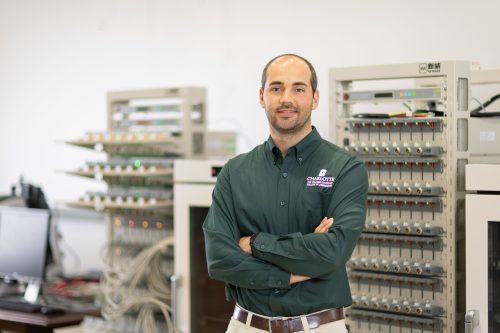
Battery safety expert Anthony Bombik explains how BATT CAVE is helping make the drive safer.
As electric vehicles become more common, engineering safer, lighter and longer-lasting battery systems is a top priority for automotive design. While lithium-ion battery packs provide efficient power, severe crash impacts, physical damage and internal overheating can trigger a dangerous chain reaction known as thermal runaway. To tackle these hazards, advanced research at UNC Charlotte’s North Carolina Battery Complexity, Autonomous Vehicle and Electrification (BATT CAVE) Research Center focuses on improving the safety of these vehicles. Researchers, led by Assistant Professor Anthony Bombik, are predicting cell failures minutes before they occur, understanding battery degradation and designing multifunctional materials that protect passengers without sacrificing vehicle range. He explains how he and his team at BATT CAVE are making electric vehicles safer on the road.
Why can EV batteries catch fire if they get damaged in a crash?
Electric vehicles rely on large lithium-ion battery packs made of thousands of individual battery cells. Inside each cell, liquid organic electrolytes carry electric charge back and forth across a polymer separator layer designed to keep opposite electrodes from coming in direct contact. However, if an EV gets into a severe car crash and the separator layer suffers a physical puncture, the internal layers of the battery can short-circuit.
This sudden physical damage can trigger a chemical chain reaction called thermal runaway, where heat builds up rapidly inside the cell and causes it to catch fire or ignite neighboring cells. At the BATT CAVE, my team and I study exactly how physical crash impacts and overheating lead to thermal runaway. We also focus on early-warning models to keep passengers safe and dual-duty materials to improve the efficiency of battery systems.
How can cars give drivers an early warning before an EV battery overheats?
When a battery cell begins to fail after an accident, subtle chemical and physical changes happen seconds or minutes before visible smoke or fire appears. To catch these early warnings, we created computer algorithms that track heat flow and predict internal chemical reactions. This allows the system to detect dangerous overheating long before standard sensors can.
The algorithm works by calculating the thermal stability of the battery rather than just monitoring temperature. This allows it to predict thermal runaway up to two minutes earlier than standard temperature thresholds are met. This extra time allows the vehicle’s computer to alert the driver, automatically isolate the damaged battery cells, or activate cooling systems before a fire can start.
What is a structural battery and how can it make EVs lighter? Can a car’s metal frame actually store electricity?
In conventional electric cars, heavy steel frames protect the battery pack from crashes, and separate cooling systems keep it from overheating. These extra protective layers and other supporting subsystems can make up as much as 42% of the battery pack’s total weight, leaving only 58% of the mass for actual energy storage.
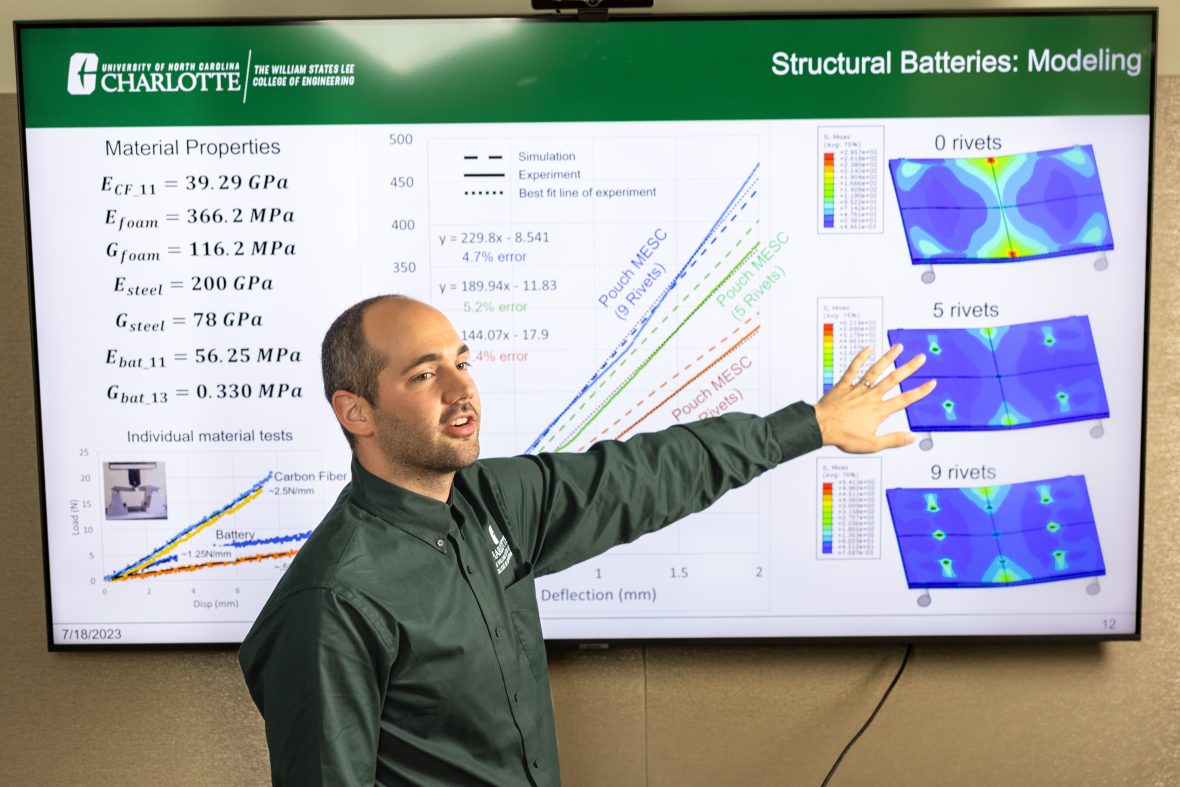
To make EVs lighter and more efficient, we design structures that safely embed traditional batteries, often referred to as structural batteries. By combining the battery, structure and health monitoring components into a single material, engineers can reduce the overall weight of the vehicle without sacrificing safety or driving range. It’s like replacing a phone’s plastic case with a built-in battery shell, so you don’t have to plug in a separate heavy power bank.
Why do EV batteries lose power over time, and do minor accidents affect battery life?
Even nominally identical lithium-ion batteries coming off the same assembly line can degrade at different rates over time due to microscopic differences inside each cell. When a car drives over a deep pothole or gets into a minor fender bender, the mechanical shock can cause tiny internal damage that accelerate battery aging without shutting the car down completely.
To solve this, we run experiments that isolate mechanical damage from electrical degradation. By using dynamic impact testing and equivalent circuit models, we analyze individual battery health inside a large pack. This allows car software to accurately estimate how much battery life remains after an impact and prevent capacity loss, helping carmakers safely unlock more driving range and longer battery life for EV owners.
How are electric car battery packs crash tested, and does that help make future electric cars safer?
Instead of relying solely on computer simulations, my team and I perform real-world mechanical and thermal abuse testing on full battery modules.
In controlled lab environments, we intentionally subject battery modules to heavy crushing impacts, punctures, extreme temperatures and overcharging. We use that heat-propagation and structural-deformation data to fine-tune computational models. These crash-test models help automobile designers create safer, impact-resistant battery pack layouts that prevent fires during high-speed highway collisions.
To learn more about cutting-edge research in electric vehicle safety and battery optimization, explore the BATT CAVE and Anthony Bombik’s research within UNC Charlotte’s William States Lee College of Engineering.
Written by: Anthony Bombik and Monica Hughes
Photos by: Amy Hart