What is Electrical Engineering?
What is Computer Engineering?
Discover what it’s like to study Electrical and Computer Engineering at UNC Charlotte. Explore the experiences, opportunities and technologies that will shape your future career.
Launch your future in Electrical and Computer Engineering with programs built for a rapidly evolving, technology-driven world. Our undergraduate programs develop a strong foundation in circuits, systems and computing while emphasizing hands-on experience and problem-solving. Our graduate programs build on that knowledge with advanced specialization and research opportunities, preparing you to design cutting-edge technologies, lead innovation and shape the future of engineering.
Our Industry Advisory Board is a select group of external leaders and experts who help guide our long-term strategy, academic programs and experiential learning opportunities.




In Electrical and Computer Engineering, faculty and students lead research at the forefront of communication systems, advanced computing, electronics and energy. From wireless networks, computer vision and AI-driven systems to embedded computing, microelectronics and smart power grids, our research spans the full spectrum of modern technology. With strengths in areas like cyber-physical systems, renewable energy, robotics and high-performance computing, students engage in hands-on discovery that connects cutting-edge theory with real-world impact and industry collaboration.
Explore recent achievements and research from our faculty, students and alumni as they advance electrical and computer engineering through innovation in artificial intelligence, cybersecurity, smart energy, wireless communications and embedded systems.

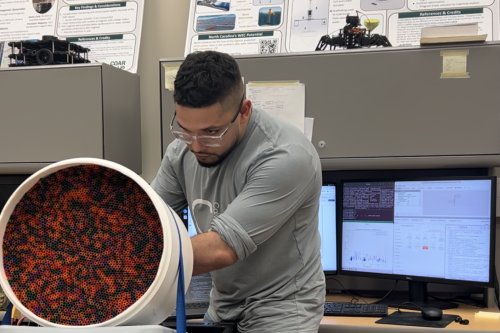

Capstone your engineering journey with real-world problem solving. In the Senior Design Program, student teams collaborate with industry partners to tackle complex, open-ended challenges, applying classroom knowledge to develop impactful solutions. This hands-on experience builds professional skills, strengthens your portfolio and prepares you to lead in engineering, business and technology.
The Bachelor of Science in Electrical Engineering (B.S.E.E.) and the Bachelor of Science in Computer Engineering (B.S.Cp.E.) degree programs within the Electrical and Computer Engineering Department at The University of North Carolina at Charlotte are accredited by the Engineering Accreditation Commission of ABET, www.abet.org, under the commission’s General Criteria and Program Criteria for Electrical, Computer, Communications, Telecommunication(s) and Similarly Named Engineering Programs.
The Electrical Engineering and Computer Engineering programs have the following student outcomes: