- Uncrewed vehicles operating in complex flow environments — modeling, flow-field mapping and estimation, and disturbance-rejection control for vehicles operating in dynamic and uncertain conditions.
- Adaptive motion control and autonomous coordination — control strategies for mobile sensing systems that adapt to uncertain or changing environments, with applications in target tracking, cooperative navigation, and informative path planning.
- Trajectory optimization and optimal path planning — development of optimal trajectories and reference paths that minimize time, energy use, or operational risk for aerospace and ocean vehicles, supporting advanced guidance, navigation, and control (GNC) and autonomous data collection missions.
Autonomous Robots and
Systems Laboratory
Research areas of expertise include
ARSL Research in Action
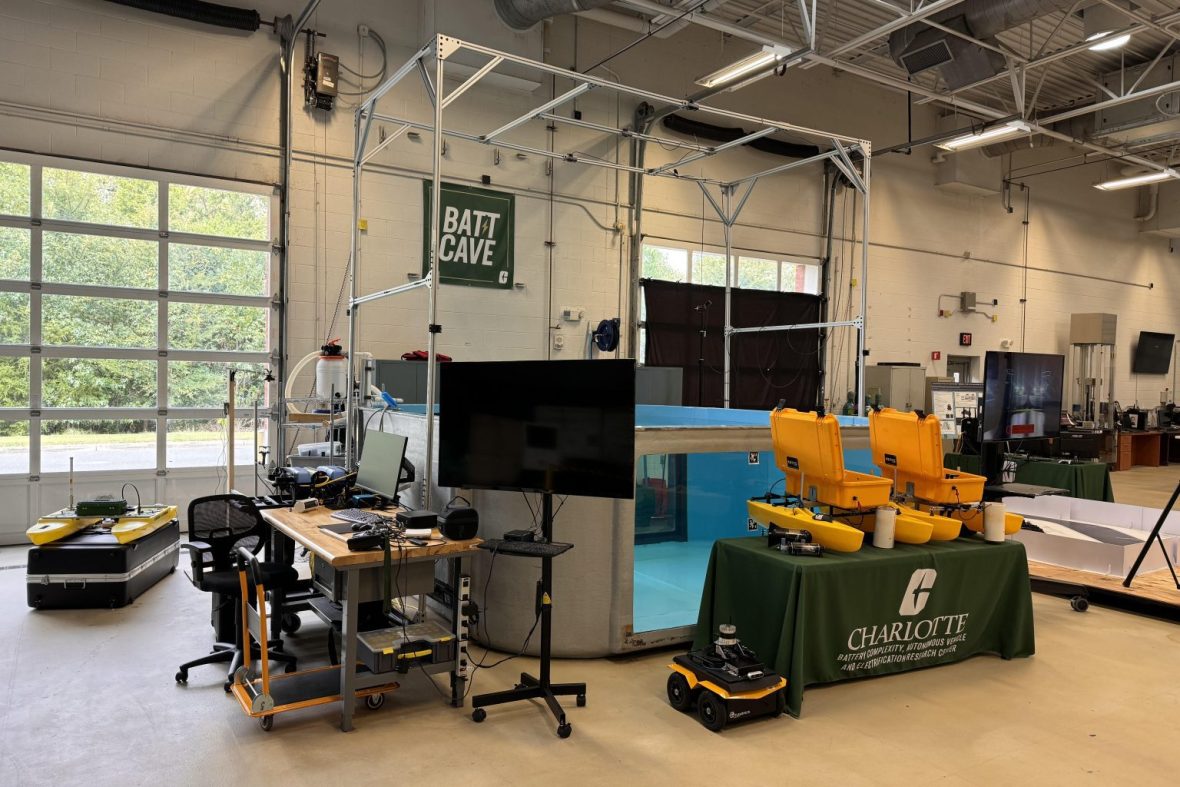
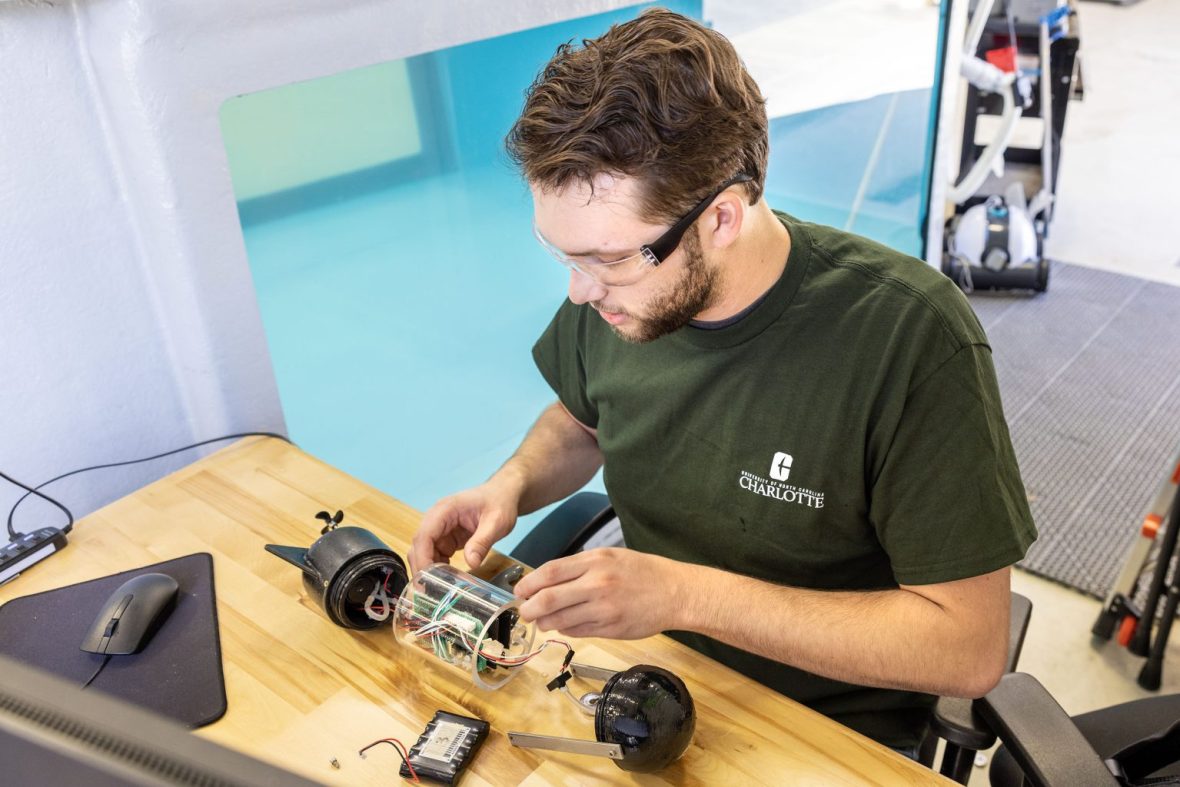
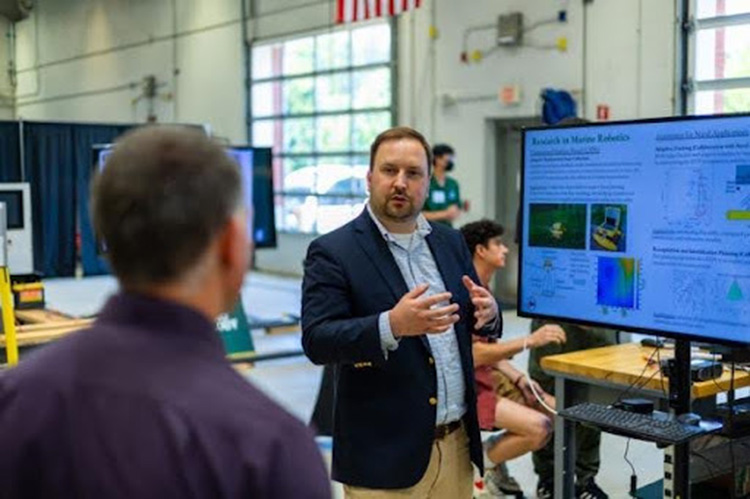
Explore videos from the Autonomous Robots and Systems Laboratory (ARSL) featuring research demonstrations, autonomous vehicle experiments, robotics testing and student-led projects in aerospace, marine and intelligent systems engineering. These videos highlight ongoing work in guidance, navigation, control, autonomous sensing and field experimentation across a range of real-world applications.
Selected Publications
Browse ARSL publications highlighting research in autonomous robotics, uncrewed systems, guidance and control, trajectory optimization and intelligent sensing technologies.
Journal Publications and Book Chapters
- A. Wolek and D. Maity, Optimal duty-cycle-based control design to regulate a linear system. Submitted.
- M. Nguyen, N. Kakavitsas, and A. Wolek, Spherical pendulum in wind: an inexpensive laboratory-scale experiment for exploring nonlinear dynamics and estimation. Submitted.
- C. Hague and A. Wolek Occlusion-aware ground target search by a UAV in an urban environment. Submitted. [preprint]
- N. Kakavitsas, A. Willis, D. Maity, and A. Wolek, Simulating the motion of a quadrotor UAV following an explosive blast, Submitted.
- C. Hague and A. Wolek, Occlusion-aware ground target tracking by a Dubins vehicle using visibility volumes. Submitted. [preprint]
- A. Wolek, I. E. Weintraub, A. Von Moll, D. Casbeer, and S.G. Manyam, Risk-aware autonomy for managing weapon engagement zones. Submitted.
- A. Nikonowicz and A. Wolek, Performance characterization of a small portable uncrewed surface vessel for bathymetry mapping near bridges using a single-beam echosounder, Drone Systems and Applications, 14:1-16, 2026.
- A. Nikonowicz and A. Wolek, A survey of uncrewed surface vessels for inland bathymetric data collection by U.S. state transportation agencies, Marine Technology Society J. Accepted. In press, 2026.
- C. Hague, A. Willis, D. Maity, and A. Wolek, Minimum-time Dubins airplane tours to inspect targets with visibility and dwell time constraints. AIAA J. Aerospace Information Systems. Accepted. In press, 2026.
- J. Zhang, A. Wolek, and A. Willis. UAV-borne mapping algorithms for low-altitude and high-speed drone applications. Sensors, 24(7):1-22, 2024. [preprint]
- M. Brancato and A. Wolek. Adaptive sampling of a stationary Gaussian spatial process by a team of robots with heterogeneous dynamics and measurement noise variance. IEEE Access, 12:94407-94423, 2024. [preprint]
- J. Jimenez, D. Stilwell, A. Wolek, J. McMahon, and B. R. Dzikowicz, Improved multitarget tracking the presence of port-starboard measurement ambiguity using the Bayes factor. IEEE J. Oceanic Engineering, 48(1):199-217, 2023.
- A. Wolek, J. McMahon, B. R. Dzikowicz, B. H. Houston, Tracking multiple surface vessels with an autonomous underwater vehicle: Field results. IEEE J. Oceanic Engineering, 47(1):32-45, 2022.
- D. A. Paley, A. A. Thompson, A. Wolek, and P. Ghanem, Planar formation control of a school of robotic fish: Theory and experiments. Frontiers in Control Engineering, 2:782121, 2021.
- A. Wolek, J. McMahon, B. R. Dzikowicz, and B. H. Houston, The orbiting Dubins traveling salesman problem: Planning inspection tours for a minehunting AUV. Autonomous Robots, 45(1), 31-49, 2021.
- A. Wolek, D. A. Paley, A 3D underwater robotic collective called Blueswarm. Science Robotics, 6(50):eabf4315, 2021.
- D. A. Paley, and A. Wolek, Mobile sensor networks and control: Adaptive sampling of spatiotemporal processes. Annual Reviews: Control, Robotics, and Autonomous Systems, 3:91-114, 2020.
- A. Wolek, S. Cheng, D. Goswami, D. A. Paley, Cooperative mapping and target search over an unknown occupancy graph using mutual information. IEEE Robotics and Automation Letters, 5(2):1071-1078, 2020.
- A. Wolek, B. R. Dzikowicz, J. McMahon, and B. H. Houston, At-sea evaluation of an underwater vehicle behavior for passive target tracking. IEEE J. Oceanic Engineering, 44(2):514-523, 2019.
- M. A. Wilson, J. McMahon, A. Wolek, D. Aha, and B. H. Houston, Goal reasoning for autonomous underwater vehicles: responding to unexpected agents. AI Comm. 31(2):151-166, 2018.
- A. Wolek and C. A. Woolsey, Model-based path planning in Sensing and Control for Autonomous Vehicles, (Eds: T. Fossen, K. Pettersen, H. Nijmeijer), Springer Lect. Notes in Control and Information Sci., pp. 183-206, 2017.
- A. Wolek, E. M. Cliff, and C. A. Woolsey, Time-optimal path planning for a kinematic car with variable speed. AIAA J. Guidance, Control, and Dynamics, 39(10):2374-2390, 2016.
- A. Wolek, E. M. Cliff, and C. A. Woolsey, Energy-optimal paths for a glider with speed and load factor controls. AIAA J. Guidance, Control, and Dynamics, 39(2):397-405, 2016.
- A. Wolek, and C. A. Woolsey, Optimal paths in still air for a sailplane with a quadratic glide polar. Technical Soaring, 40(2):9-23, 2016.
- A. Wolek, and C. A. Woolsey, Feasible Dubins paths in the presence of unknown, unsteady velocity disturbances. AIAA J. Guidance, Control, and Dynamics, 38(4):782-787, 2015.
- O. Bilgen, L. Butt, S. Day, C. Sossi, J. Weaver, A. Wolek, W. Mason, and D. Inman, A novel unmanned aircraft with solid-state control surfaces. J. Intelligent Material Systems and Structures, 24(2):147-167, 2012.
Conference Proceedings
- F. Rankin, A. Wolek, A. Willis, and D. Maity, Neural switching control with Lyapunov stability guarantees for robust multi-controller UAV operation. Submitted.
- Z. Hashemi, D. Maity, and A. Wolek, POWER-Net: Predictive optimization and wave energy regulation in networked WEC systems. In Proc. 2025 University Marine Energy Research Community (UMERC) Annual Conference, Corvallis, OR, 2025.
- I. Albool, A. Willis, A. Wolek, and D. Maity, A reinforcement learning framework to adaptively schedule controllers for UAVs operating under harsh environmental conditions. In Proc. 2025 International Conference on Unmanned Aerial Systems (ICUAS), Charlotte, NC, 2025.
- C. Beam, A. Wolek, and A. Willis, Recreation of 3D UAS flights in high-realism virtual environments, In Proc. 2025 International Conference on Unmanned Aerial Systems (ICUAS), Charlotte, NC, 2025.
- S. Parab, A. Wolek, D. Maity, and A. Willis, Real-time simulation of complex 4D wind fields and gusts for UAS control system development, In Proc. 2025 International Conference on Unmanned Aerial Systems (ICUAS), Charlotte, NC, 2025.
- C. Hahn, A. Wolek, and M. Uddin, Characterizing vortex ring state during UAV landing on a ground vehicle using CFD, In Proc. AIAA SciTech 2025 Forum, Orlando, FL, 2025.
- N. Kakavitsas and A. Wolek, Mapping urban wind fields via Gaussian processes regression models that consider building morphology, In Proc. AIAA SciTech 2025 Forum, Orlando, FL, 2025. [preprint]
- N. Kakavitsas, A. Willis, D. Maity, and A. Wolek, A quadrotor model for evaluating dynamic response to a blast pressure wave, In Proc. AIAA SciTech 2025 Forum, Orlando, FL, 2025. [preprint]
- A. Wolek, D. Casbeer, I. Weintraub, and A. Von Moll, Maximum kinetic energy paths for a decaying-speed Dubins vehicle, In Proc. AIAA SciTech 2025 Forum, Orlando, FL, 2025. [preprint]
- H. Moradi, A. Wolek, and S. D. Kelly, Mechanics and control of a freely rolling two-link robot with joint actuation, In Proc. IFAC 2024 Modeling, Estimation and Control Conference, Chicago, IL, 2024.
- A. Wolek, I. E. Weintraub, A. Von Moll, D. Casbeer, and S.G. Manyam, Sampling-based risk-aware path planning around dynamic engagement zones, In Proc. IFAC 2024 Modeling, Estimation and Control Conference, Chicago, IL, 2024. [preprint]
- A. Wolek, Path planning for a cooperative navigation aid vehicle to assist multiple agents sequentially. In Proc. 15th IFAC Conference on Control Applications in Marine Systems, Robotics, and Vehicles, Blacksburg, VA, 2024. [preprint]
- A. Wolek and J. McMahon, Batch estimation of a steady, uniform, flow-field from ground velocity and heading measurements. In Proc. 15th IFAC Conference on Control Applications in Marine Systems, Robotics, and Vehicles, Blacksburg, VA, 2024. [preprint]
- C. Beam, J. Zhang, N. Kakavitsas, C. Hague, A. Wolek, and A. Willis, Cesium Tiles for high-realism simulation and comparing SLAM results in corresponding virtual and real-world environments. In Proc. 2024 IEEE Southeast Con, Atlanta, GA, 2024. [preprint]
- A. Willis, C. Hague, A. Wolek, and K. Brink, GPU-Accelerated 3D polygon visibility volumes for synergistic perception and navigation. In Proc. 2024 IEEE Southeast Con, Atlanta, GA, 2024. [preprint]
- C. Hague, N. Kakavitsas, J. Zhang, C. Beam, A. Willis, and A. Wolek, Design and flight demonstration of a quadrotor for urban mapping and target tracking applications. In Proc. 2024 IEEE Southeast Con, Atlanta, GA, 2024. [preprint]
- J. Herbert and A. Wolek, Design of a miniature underwater vehicle and data collection system for indoor experimentation. In Proc. 2024 IEEE Southeast Con, Atlanta, GA, 2024. [preprint]
- N. Kakavitsas, A. Willis, R. Jacobik, M. Uddin, and A. Wolek, Quadrotor flight simulation in a CFD-generated urban wind field. In Proc. 2024 IEEE Aerospace Conference, Big Sky, MT, 2024. [preprint]
- N. Kakavitsas, A. Willis, J. Conrad, and A. Wolek, Comparison of size and performance of small vertical and short takeoff and landing UAS. In Proc. 2024 IEEE Aerospace Conference, Big Sky, MT, 2024. [preprint]
- N. Kakavitsas and A. Wolek, Quadrotor takeoff trajectory planning in a one-dimensional uncertain wind-field aided by wind-sensing infrastructure. In Proc. AIAA SciTech 2024 Forum, Orlando, FL, 2024. [preprint]
- A. Wolek and D. A. Paley, Output feedback formation control of a school of robotic fish with artificial lateral line sensing. In Proc. IEEE/RSJ Int. Conf. Intelligent Robots Sys., Detroit, MI, 2023. [preprint]
- C. Hague, A. Willis, D. Maity, and A. Wolek, Planning visual inspection tours for a 3D Dubins airplane model in an urban environment. In Proc. AIAA SciTech 2023 Forum, National Harbor, MD, 2023. [preprint]
- D. Goswami, A. Wolek, D. A. Paley, Data-driven estimation using an Echo-State Neural Network equipped with an Ensemble Kalman Filter. In Proc. 2021 American Control Conference, New Orleans, LA, 2021. [preprint]
- P. Ghanem, A. Wolek, D. A. Paley, Planar formation control of a school of robotic fish. In Proc. 2020 American Control Conference, Denver, CO, 2020. [preprint]
- H. Yetkin, J. McMahon, N. Topin, A. Wolek, Z. Waters, and D. Stilwell, Online planning for autonomous underwater vehicles performing information gathering tasks in large sub-sea environments. In Proc. IEEE/RSJ Int. Conf. Intelligent Robots Sys., Macau, China, 2019.
- J. G. Jimenez, A. Wolek, D. Stilwell, J. McMahon, and B. Dzikowicz, Experimental results in bearings-only tracking with the sequential Monte-Carlo probability hypothesis density filter. In Proc. SPIE Defense + Commercial Sensing, Baltimore, MD, 2019.
- B. Simmons, P. Adwani, H. Pham, Y. Alhuthifi, and A. Wolek, Training a remote-control car to autonomously lane-follow using end-to-end neural networks. In Proc. IEEE Conf. Info. Sci. Sys., Baltimore, MD, 2019.
- J. McMahon, H. Yetkin, A. Wolek, Z. Waters, and D. J. Stilwell, Towards real-time search planning in subsea environments. In Proc. IEEE/RSJ Int. Conf. Intelligent Robots Sys., Vancouver, Canada, 2017. [preprint]
- M. A. Wilson, J. McMahon, A. Wolek, D. Aha, and B. Houston, Toward goal reasoning for AUVs: responding to unexpected agents. In Proc. Workshop on Goal Reasoning at the 25th Int. Joint Conf. Artificial Intelligence, New York, NY, 2016.
- A. Wolek, T. Gode, C. A. Woolsey, J. Quenzer, K. A. and Morgansen, Testing a pneumatic underwater glider in shallow water. In Proc. MTS/IEEE OCEANS’15, Washington, DC, 2015. [preprint]
- A. Wolek, and C. A. Woolsey, Disturbance rejection in Dubins path planning. In Proc. American Control Conf., Montreal, Canada, 2012.
- A. Wolek, J. Burns, C. A. Woolsey, J. Quenzer, L. Techy, and K. A. Morgansen., A maneuverable, pneumatic underwater glider. In Proc. MTS/IEEE OCEANS’12 Conf. and Expo., Hampton Roads, VA, 2012.
- S. Fan, A. Wolek, and C. A. Woolsey, Stability and performance of underwater gliders. In Proc. MTS/IEEE OCEANS’12 Conf. and Expo., Hampton Roads, VA, 2012.
- O. Bilgen, L. Butt, S. Day, C. Sossi, J. Weaver, A. Wolek, W. Mason, and D. Inman, A novel unmanned aircraft with solid-state control surfaces. In Proc. 52nd AIAA Structural Dynamics and Materials Conf., Denver, CO, 2011.
- M. C. Cotting, A. Wolek, J. F. Murtha, C. and A. Woolsey, Developmental flight testing of the SPAARO UAV. In Proc. 48th AIAA Aerospace Sciences Meeting and Expo., Orlando, FL, 2010. [preprint]
- J. F. Murtha, M. C. Cotting, A. Wolek, T. Aarons, and C. A. Woolsey, The educational impact of creating a new UAV for curriculum enhancement. In Proc. AIAA Atmospheric Flight Mech. Conf., Chicago, IL, 2009.
Undergraduate Research
- A. Das, Aero-acoustic optimization and experimental validation of a NACA 2415 toroidal UAV propeller. Submitted.
- M. Nguyen, Off-road terrain mapping for autonomous ground vehicle energy-optimal path planning, In Proc. AIAA 2025 Region II Student Conference, Greensboro, NC, 2025.
- K. VanHorn, Experimental characterization of a quadrotor’s response to an air vortex cannon, In Proc. AIAA 2025 Region II Student Conference, Greensboro, NC, 2025.
- K. VanHorn, Machine-learning-based wind detection and avoidance using a crazyflie micro drone. In Proc. AIAA 2024 Region II Student Conference, Kennedy Space Center, FL, 2024.
Interested in Joining ARSL?
We welcome motivated students interested in robotics, autonomous systems, and advanced control research.
Graduate Students (M.S. & Ph.D.)
We are actively recruiting graduate students, with strong encouragement for outstanding UNC Charlotte seniors to apply. Interested applicants should email awolek@charlotte.edu with a brief introduction, CV/resume, and transcripts. Please review our recent publications and research areas and include a short note on how your interests align with the lab.
Undergraduate Students (UNC Charlotte)
Highly motivated undergraduate students may be considered for research opportunities in the lab. Competitive applicants typically have a strong academic record (approximately 3.5 GPA or higher), have completed key coursework in dynamics and related technical electives, and demonstrate interest in robotics, controls, or aerospace systems. Students planning to pursue graduate study are especially encouraged to apply by email.
High School Students
The lab does not currently host high school researchers. However, students are encouraged to explore UNC Charlotte’s Camps on Campus programs, which have previously included aerospace and engineering-themed experiences.
Contact Our Team
Nicholas Kakavitsas

Dustin Sims