School of Energy
See Energy Training in Action
Get a closer look at the School of Energy at UNC Charlotte, where hands-on learning meets real-world impact. Explore how students apply electrical and mechanical systems to solve industry challenges and build skills that lead directly to high-demand careers.
Explore programs designed to prepare you for impact.
Launch your future with School of Energy programs designed to turn knowledge into action. Our undergraduate programs focus on applied learning, giving you hands-on experience with modern systems, tools and technologies used in today’s industries. Graduate programs build on that foundation with advanced technical skills and leadership development, preparing you to solve complex challenges, improve systems and advance your career in a rapidly evolving, technology-driven world.
Research Areas
Explore research that turns ideas into real-world impact. In the School of Energy at UNC Charlotte, students and faculty collaborate on applied research in areas like advanced manufacturing, robotics, data and digital technologies, energy systems and sustainability. With a strong focus on industry partnerships and hands-on problem-solving, research goes beyond theory, giving you the opportunity to work on projects that address real challenges, drive innovation and prepare you for today’s technology-driven careers.
Latest News from the School of Energy
Explore recent achievements and applied research from our faculty, students and alumni as they drive innovation, develop practical engineering solutions and shape the future of advanced manufacturing, automation and technology.
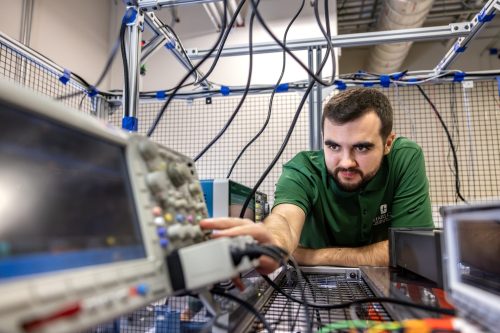
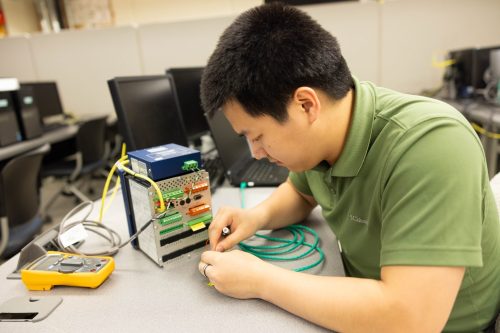

Senior Design Program
Capstone your engineering journey with real-world problem solving. In the Senior Design Program, student teams collaborate with industry partners to tackle complex, open-ended challenges, applying classroom knowledge to develop impactful solutions. This hands-on experience builds professional skills, strengthens your portfolio, and prepares you to lead in engineering, business and technology.
Accreditation
The Bachelor of Science in Electromechanical Engineering Technology degree program within the School of Energy at the University of North Carolina at Charlotte is accredited by the Engineering Technology Accreditation Commission of ABET, www.abet.org, under the commission’s General Criteria and Program Criteria for Electromechanical Engineering Technology.
The Bachelor of Science in Mechanical Engineering Technology degree program within the School of Energy at the University of North Carolina at Charlotte is accredited by the Engineering Technology Accreditation Commission of ABET, www.abet.org, under the commission’s General Criteria and Program Criteria for Mechanical Engineering Technology.
Program Educational Objectives
The School of Energy at UNC Charlotte is committed to providing the environment and expertise to ensure that its graduates may make substantive contributions in their professional endeavors after graduation, both in the areas of technical proficiency and community involvement. These program educational objectives are statements that describe the expected accomplishments of graduates during the first few years after graduation.
Electromechanical Engineering Technology:
- Apply general and discipline-specific concepts and methodologies to identify and
provide operational and technical solutions - Effectively communicate information and lead discussion in a professional
manner to potentially diverse audiences and in a variety of formats - Show growth within independent and team environments while modeling ethical,
respectful, reliable and professional behavior - Understand and adapt to the impact of the environmental, societal and economic
complexities on the profession in local, national and global contexts - Demonstrate lifelong learning skills through certifications, professional
development, and licensure
Mechanical Engineering Technology:
- Apply general and discipline-specific concepts and methodologies to identify and
implement operational and technical solutions - Effectively communicate information and lead discussion in a professional
manner to a variety of audiences in multiple formats - Recognition of career progression in independent and team environments while
modeling ethical, respectful, reliable, and professional behavior - Understand and adapt to the impact of the environmental, societal and economic
complexities on the profession in local, national, and global contexts - Demonstrate lifelong learning skills through certifications, professional
development, and licensure
Student Outcomes
School of Energy programs identify, measure, and improve student competencies through assessment and continuous improvement of student learning outcomes, which are mapped to the ETAC of ABET Criterion 3 Outcomes listed below:
ETAC of ABET Criterion 3 Outcomes
For baccalaureate degree programs, these student outcomes must include, but are not limited to, the following:
- An ability to apply knowledge, techniques, skills and modern tools of mathematics, science, engineering, and technology to solve broadly-defined engineering problems appropriate to the discipline;
- An ability to design systems, components, or processes meeting specified needs for broadly-defined engineering problems appropriate to the discipline;
- An ability to apply written, oral, and graphical communication in broadly defined technical and non-technical environments; and an ability to identify and use appropriate technical literature;
- An ability to conduct standard tests, measurements, and experiments and to analyze and interpret the results to improve processes; and
- An ability to function effectively as a member as well as a leader on technical teams.